
Reducing food waste in rural areas requires more than isolated actions. It requires a systemic approach that connects production, transformation, distribution and consumption within a coherent sustainability framework.
In RULESSWASTE, CAPSA brings a strong territorial foundation built on sustainability, circular economy principles and measurable environmental impact in Asturias.
A cooperative model with measurable impact
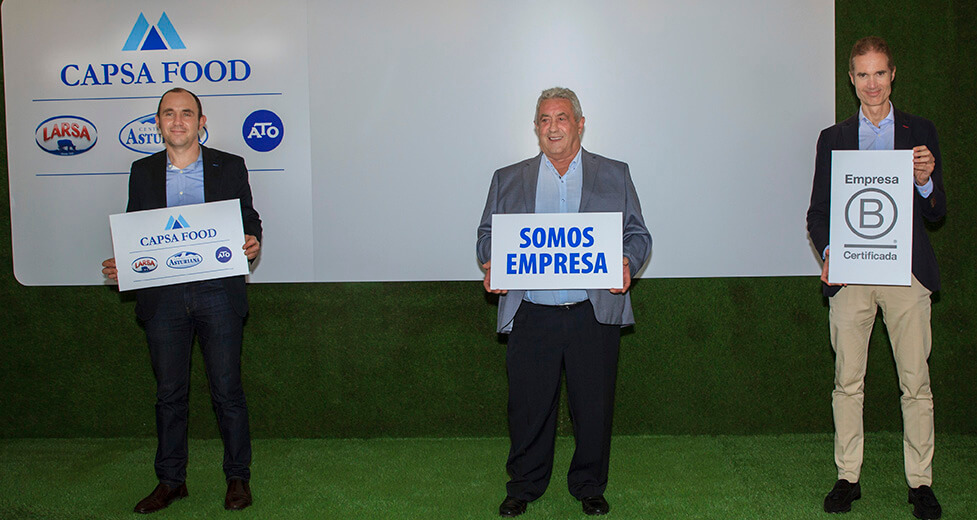
CAPSA’s cooperative business model integrates economic growth, environmental responsibility and community wellbeing. This approach has been internationally recognised through its B Corp certification, making it the first dairy company in Spain to obtain this distinction.
The B Corp certification reflects high standards of social and environmental performance, accountability and transparency, evaluated across key categories such as community, workers, governance, environment and customers.
This long-term impact vision aligns naturally with the objectives of RULESSWASTE: addressing food waste as part of a broader commitment to sustainable rural development.
Circular economy from farm to table
CAPSA has implemented a comprehensive circular economy strategy across its entire value chain — from livestock farming to distribution and post-consumption.
Key elements include:
- Organic waste transformation into biogas and biofertilisers.
- Optimised milk collection routes and the incorporation of more sustainable transport solutions.
- Purchase of renewable electricity with guarantees of origin.
- Progressive installation of photovoltaic capacity in farms and facilities.
- More than 97% of waste given a second life, with all factories certified as Zero Waste.
This systemic circularity framework reinforces the relevance of RULESSWASTE, where understanding resource flows is essential to reducing food waste effectively.
Climate action as structural commitment
CAPSA has reduced its direct emissions (Scope 1 and 2) by 64% since 2019 and has formally registered its carbon footprint.
Beyond operational reductions, the company promotes innovation initiatives focused on sustainable livestock farming, carbon neutrality and research into lower-emission production systems.
This commitment to decarbonisation forms part of a broader sustainability strategy that directly connects with the ambitions of RULESSWASTE.
A solid foundation for action
CAPSA’s participation in RULESSWASTE is grounded in:
- A certified circular economy strategy.
- A cooperative business model with recognised social impact.
- Measurable environmental performance indicators.
- Strong territorial roots in Asturias.
By combining local anchoring with structural sustainability, the project builds on an existing ecosystem already committed to environmental and social responsibility.
Reducing food waste in rural areas is not only a technical challenge. It is also about strengthening responsible territorial models capable of generating long-term impact.


