
About Project
Food waste is one of today’s most pressing global challenges. Every year, around 1.05 billion tons of food are wasted worldwide, contributing to economic loss, environmental degradation, and social inequality. In the EU alone, food waste generates 59 million tons annually at a cost of €132 billion, with significant impacts on greenhouse gas emissions, land use, water consumption, and biodiversity. Households are the main contributors, followed by the food industry, primary production, restaurants, and retail.
While much of the existing research and policy action has focused on urban areas, rural regions face unique challenges that have been largely overlooked. In many rural communities, uneaten food is often fed to animals or thrown directly into waste bins. Despite being areas strongly linked to food production, rural territories still generate considerable food waste at household and producer levels. These regions also face demographic pressure, limited income resources, and barriers to accessing fresh food, making Harvest Valorization especially relevant.
RULESSWASTE addresses this gap by working in five representative rural municipalities in Asturias (Spain) to understand the drivers of inefficient resource use and co-design solutions tailored to the realities of rural life. The project aims to promote behavioural change, strengthen community engagement, and support citizens, businesses, schools, NGOs, and local authorities in adopting sustainable practices.
The initiative follows a holistic, circular-economy perspective, aligned with the FAO’s Target-Measure-Act (TMA) methodology. Actions include identifying critical hotspots, gathering local data, developing reduction targets, implementing interventions, and evaluating their impact for future scalability in other EU rural regions.
A central innovation of RULESSWASTE is the development of a Blockchain-based Food Resource Stewardship Platform composed of two dashboards:
• one to collect, analyse, and visualise data to support better decision-making;
• another that creates a digital interaction space connecting food resource generators and potential consumers.
This platform enhances traceability, transparency, and community collaboration.
The project is jointly implemented by NARIA, a digital-innovation start-up with deep expertise in food surplus management and multi-stakeholder coordination, and CAPSA FOOD, a leading agri-food company in Asturias with strong influence and capacity to mobilise local actors. Together, they work to ensure active involvement of all stakeholders—from youth and elder citizens to farmers, schools, businesses, NGOs, and local authorities—making the project inclusive and community-driven.
Ultimately, RULESSWASTE seeks to deliver scalable and replicable models for rural food waste reduction, improve sustainability, and generate positive environmental, social, and economic impacts over time.
project objetives
Food Waste Diagnosis
Identify the causes, patterns, and hotspots of food waste in five rural municipalities in Asturias.
Provide a solid evidence base to guide targeted actions and interventions.
Co-Design with Communities
Develop practical, community-driven interventions tailored to the realities of rural life.
Ensure that citizens and local actors actively shape solutions that fit their daily context.
Implementation of Actions
Implement solutions across households, schools, retailers, NGOs, and local authorities to promote behavioural change.
Test and refine interventions directly within the participating communities.
Blockchain Digital Platform
Create a blockchain-based platform to collect, analyse, and visualise data, and support surplus food redistribution.
Improve traceability and transparency across the entire local food system.
Evaluation & Impact
Evaluate the outcomes of interventions and generate a replicable model for other rural EU regions.
Identify key success factors and lessons learned for wider adoption.
Community Engagement
Strengthen citizen participation and collaboration among administrations, businesses, schools, and social organisations.
Build long-term awareness and shared responsibility for reducing food waste.
work plan
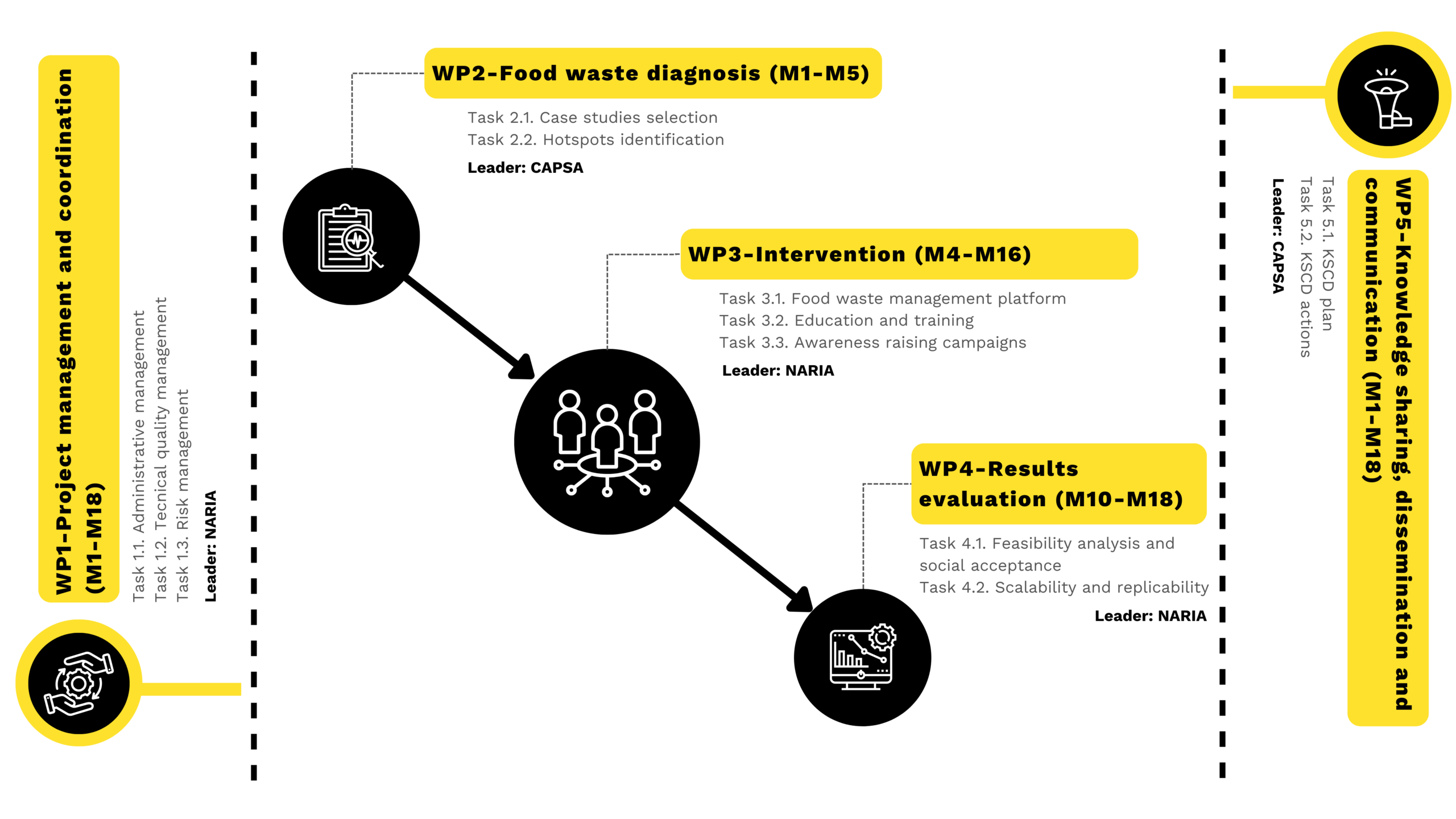
RULESSWASTE is structured into five work packages that run partly in parallel to move from diagnosis to action and impact.
-
-
- WP1 – Project management and coordination (M1–M18)
Ensures smooth administrative and technical management of the project, monitors progress, and manages risks so that all activities stay on track. - WP2 – Food waste diagnosis (M1–M5)
Selects the five rural case studies in Asturias and identifies food waste hotspots, actors and practices. This evidence provides the baseline for setting targets and designing tailored interventions. - WP3 – Intervention (M4–M16)
Designs and implements the food-resource stewardship platform, education and training activities, and awareness-raising campaigns in households, schools, businesses and local entities. - WP4 – Results evaluation (M10–M18)
Analyses the feasibility, effectiveness and social acceptance of the interventions, and assesses their scalability and replicability to other rural areas in Spain and the EU. - WP5 – Knowledge sharing, dissemination and communication (M1–M18)
Translates project results into clear messages and resources, engaging citizens, stakeholders and decision-makers through events, materials and digital channels to support long-term change.
- WP1 – Project management and coordination (M1–M18)
-
Partners
Our Team RULESSWASTE is driven by a strategic alliance between two complementary entities. We combine deep technological expertise in social innovation with strong regional influence in the agri-food sector to ensure the project’s success in rural Asturias.
NARIA
NARIA TECH (Coordinator)
NARIA is a digital-innovation start-up with a clear social mission: to digitise the third sector and strengthen connections between food surplus generators and consumers.
Role in RULESSWASTE:
As the project coordinator, NARIA leads the technological development of the blockchain-based platform and oversees the project’s overall management.
Expertise: NARIA contributes extensive know-how in designing and implementing digital ecosystems for food banks and social organisations, ensuring traceability, transparency, and efficient redistribution of food resources across rural municipalities.
Purpose: Through its technological expertise, NARIA enables the creation of tailored, data-driven interventions that identify food waste hotspots, facilitate community engagement, and support the implementation of sustainable food resource stewardship practices across Asturias.
CAPSA FOOD
CAPSA FOOD (Beneficiary)
Corporación Alimentaria Peñasanta S.A. (CAPSA) is a leading Spanish agri-food company with a deep presence and strong social influence in Asturias. CAPSA plays a key role in connecting local stakeholders and strengthening rural development initiatives.
Role in RULESSWASTE: CAPSA leads engagement with local communities, coordinating the diagnosis of food resource inefficiency hotspots in rural municipalities and managing communication and dissemination activities.
Expertise: With its long-standing presence in the territory, CAPSA facilitates direct access to farmers, local businesses, and households, ensuring that the project’s solutions are understood, adopted, and supported by the community.

This project has recieved funding from the European Single Market Programme (SMP-FOOD-2024-FW-STAKEHOLDERS-PJ) under the Grant Agreement: 101216689

Funded by the European Union. Views and opinions expressed are however those of the author(s) only and do not necessarily reflect those of the European Union. Neither the European Union nor the granting authority can be held responsible for them.

